The Fantasy Trip is a fantasy roleplaying game streamlined for fast learning and fast play but still rich enough for meaningful character differentiation and deep tactical play. In fact, just running fights or wizardly duels is a great game.
Description

The original game that started it all, Melee, is available as a free pdf from Warehouse 23 or DriveThruRPG. That only includes the rules for man-to-man combat, but that's a lot.

Characters in The Fantasy Trip have three attributes, ST, DX, and IQ. The human average for each of these is 10, but a starting character these will total 32 so they're a little above average.

ST is Strength, and governs what weapons a character can use. It is also how many hit points a character has. You'll roll against ST when trying to resist poison or move something heavy. ST also determines how much a character can carry before movement penalties.

ST Example
4House Cat
8Human minimum
9Rapiers and other very light weapons
10Human average
11Wield Longbow
15Wield Battle Axe
24Warhorse, Lion
30Bear, Giant, or 4-Hex Dragon

DX is Dexterity, you'll roll against this when trying to hit in combat, keep your feet on unsteady ground, and so on. After movement characters will take their actions in DX order, so higher DX characters will attack first.

Note that armor or a larger shield reduces your DX, so you will usually be comparing or rolling against Adjusted DX or adjDX.

DX % <=DX on 3d Example
69.25%Horse
826%Human minimum
937.5%
1050%Human Average
1162.5%Human average
1274%Minimum for Fencer
1384%
1491%Minimum for Master Fencer or Weapon Mastery

IQ is intelligence. This determines what Talents and Spells a character can learn.

IQ Example
5Wolf or Bear
6Horse
8Literacy
9Priest or Bard
10Human average
11Locksmith, Fencer, Physicker
13Mathematician, Scholar, Chemist
14Alchemist

All rolls in TFT use six sided dice and most are done with three dice, or 3d.

Total ≤ Probability
937.5%
1050.0%
1162.5%
1274.1%
1384.3%

When rolling to hit in combat a 5 always hits, a 4 always hits and you double your damage roll, and a 3 always hits and you do triple damage. The other side of the coin, though, is that a 16 always misses, a 17 misses and you drop your weapon, and on an 18 you break your weapon.

When facing a disadvantage such as a foe who is forgoing their attack to focus on defense or a particularly well-hidden trap a character may have to make their roll on four or even more dice.

Each turn in combat follows this sequence:

1. Initiative - each side rolls a die, highest chooses whether to go first or second. If both sides roll the same number they roll again. This can make a big difference.

2. Movement - each side moves their characters, one at a time. An engaged character can shift one hex, and must remain adjacent to the figures engaging them. An unengaged character can move up to their (MA) in hexes, but the farther they move the fewer options are available to them during the action phase. EG, a character can move half their MA and still attack, but if they move more than half their MA they can't attack.

3. Actions - attacks, spells, disengagement, and other actions are resolved in DX order ties broken by Initiative.

4. Forced Retreats - any fighter that inflicted hits on a foe with a physical attack but did not take damage can force that foe to retreat one hex.
Movement

A character is engaged if they are in an enemy's front hex.

An unengaged character can move one hex and then during the action phase cast a spell, fire a missile weapon. They can move up to two hexes and change weapons (reslinging the original one). They can move up to half their MA and attack, or move up to their MA and do nothing else.

Engagement
Initiative
MA
Description

When a character attacks the player rolls 3d, aiming to roll the character's adjDX or less. If the roll is successful the player rolls damage for their weapon. The target's shield and armor will reduce this number. If a character takes 5 hits in a turn their adjDX is reduced by 2 for one turn, and if they take 8 hits in a turn they are knocked down.

In this example

Pole Weapons such as spears have advantages in a charge attack, that is the turn when two fighters move into contact with each other. Pole weapons attack before other types, there's a +2DX bonus for a pole weapon receiving a charge, and if either party moved three or more hexes in a straight line before contact they do an extra die of damage. In addition, the longer pole weapons can Jab targets two hexes away.

Some weapons such as spears, axes, and daggers can be thrown, even after moving half your MA. There is a DX penalty of -1 per hex distance between the throwing character and the target.

Missile weapons such as bows can attack at greater distances. There's less of a penalty for distance, but these weapons can be used at a great distance.

Still more exotic weapons such as lassos, throwing stars, and nets have their own special effects...

Description
Remove Traps

Talents give your character specific abilities, allowing them to do things others can't.

Each talent has a minimum IQ requirement, as well as a 'cost', which is how many IQ points are required to cover the training and practice to maintain that talent. So a character can learn a number of talents with a total cost equal to their IQ. Some talents like Literacy, languages, and Swimming cost only a single point, Alertness or Pole Weapons cost 2, and a few such as Alchemy and Master Fencer cost 3.

A talent can be a natural quality like Alertness, Toughness, or Charisma, a practiced skill like Bow or Bard, or an area of study such as Naturalist or Chemist.

A Wizard's magical training allows them to learn spells efficiently, even if it means they are less able to learn mundane talents. Spells have an IQ requirement like Talents, and each spell occupies one IQ point. Wizards can learn Talents, but those talents will cost twice as much. An ordinary hero can learn spells, too, but they cost 3.

Loading...

A wizard casts a spell they know when their turn to act comes. They need to make a DX roll, which may have a range penalty if it's a thrown spell (T) or missile spell (M). If they fail the roll they lose one point of fatigue, if they succeed they pay the spell's normal cost and the spell takes effect.

Fatigue is also based on ST. Fatigue and wounds are added together when assessing whether a character falls unconscious or is killed, the difference is that you can recover a point of fatigue in fifteen minutes of rest, while recovering a point of wounds takes two days of rest.

Sample Fighter
Description

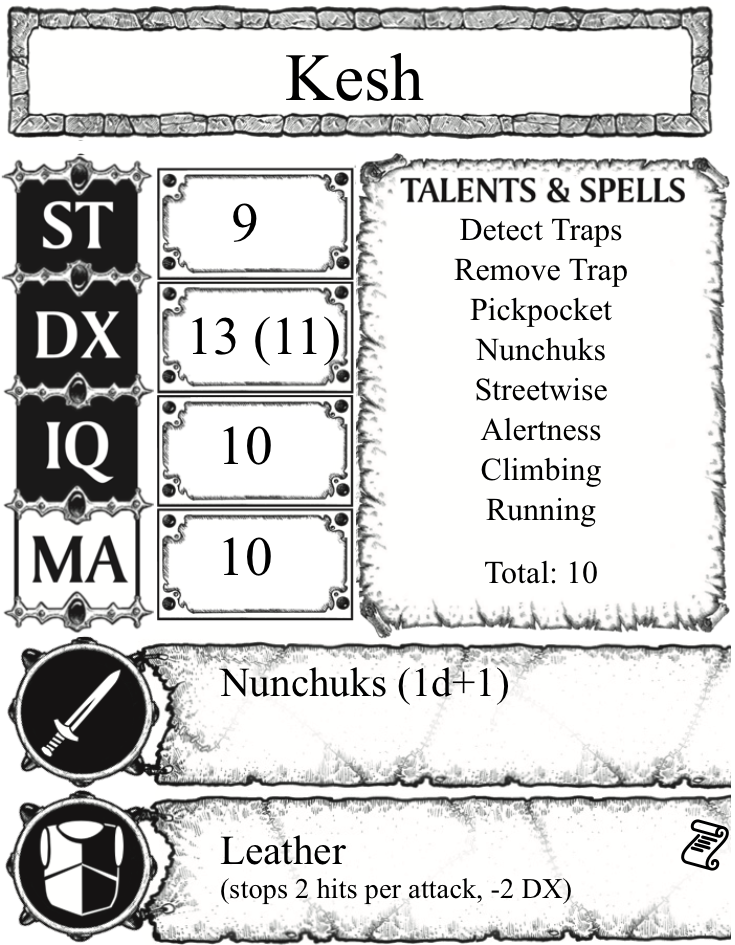
Kesh is a "rogue" of the classic type: a good infiltrator and handy at dispatching traps. A 62% chance to hit with 1d+1 damage from the nunchuks and 2 points of protection from the leather armor is not bad at all.

An interesting variation if you're not expecting urban adventures would be to drop Streetwise and Pickpocket for Silent Movement.

Note that normally Leather armor would reduce MA to 8, but Kesh's running Talent brings their MA back up to 10. If they went without the Leather armor and it's 2 points of protection MA would be 12. They could move six hexes and still attack! And with a DX of 13 the Nunchuk's double attack option at -4 DX becomes interesting, especially if Kesh earns XP and spends it on even higher DX.

Description

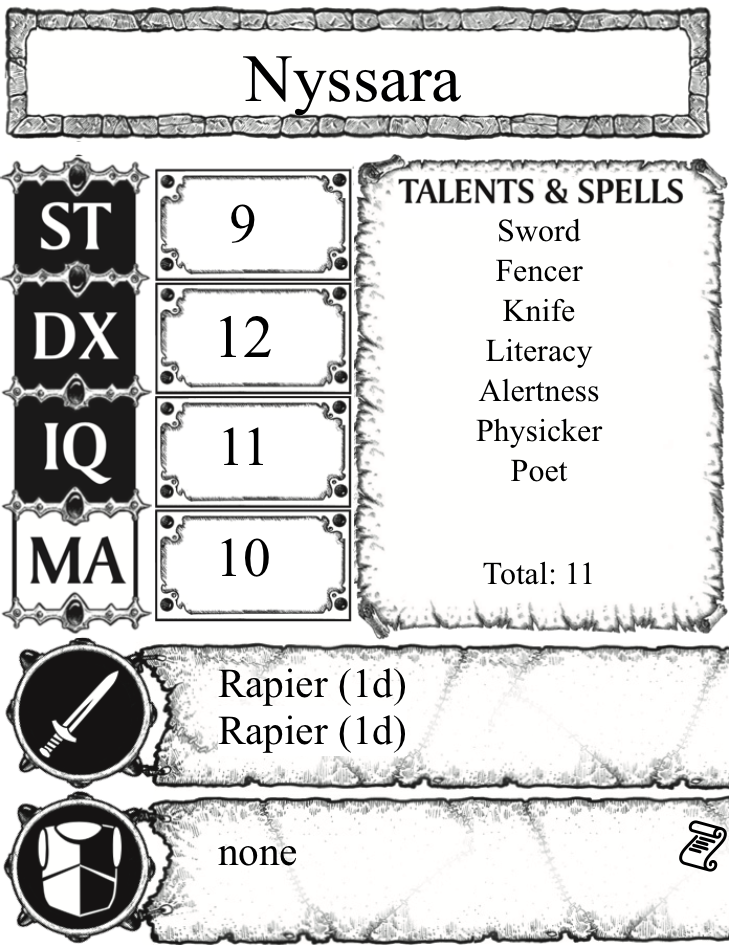
Nyssara is a more educated fighter. She's good to have around, not necessarily because of the poetry but because her Physicker talent lets her take five minutes after the fight to bandage wounds and remove two hits of damage.

The Fencer talent gives her some interesting advantages in combat including giving her opponents -1 DX on attacks against her and giving her an extra point of damage when she hits. If she wants to accept a DX penalty she can attack with both weapons or try for a Shrewd Blow with even more damage. Most importantly, since she must have adjDX of 12 to use Fencer and thus can't wear armor, if she attacks with only one rapier the other can parry two points of damage, the equivalent of leather armor.

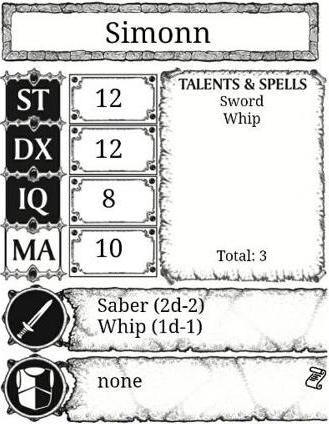
Of course, her rapier doesn't do a lot of damage, but if she spends some XP on increasing her ST to 10 she could upgrade to a Saber that does 2d-2.

Description

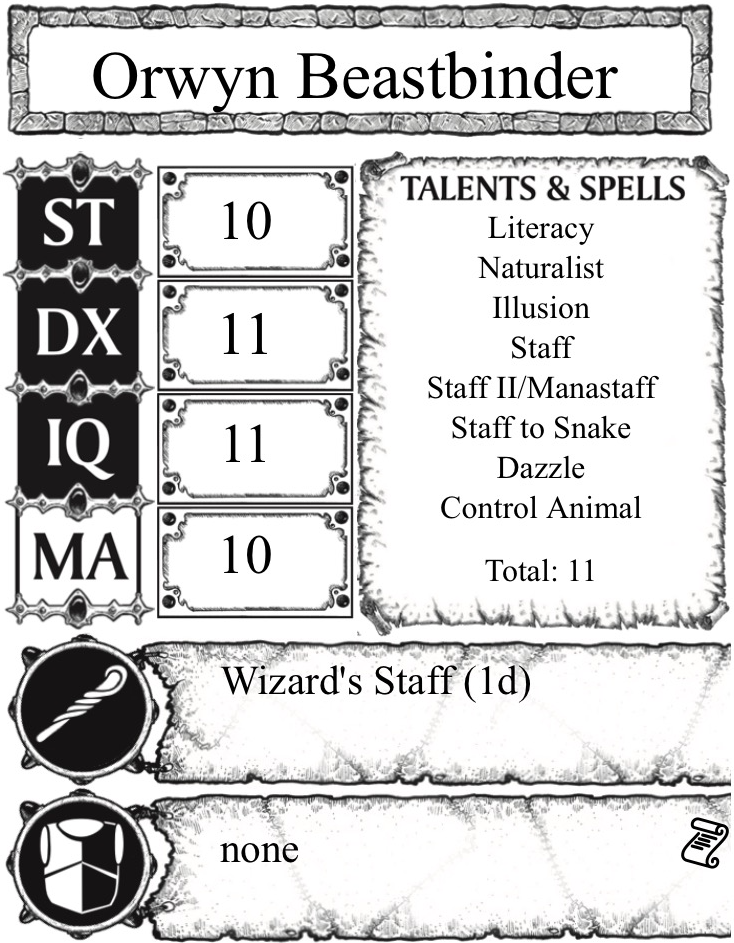
Orwyn is a great example of a wizard torn between two worlds, in this case magic and creatures. The Naturalist talent takes the place of four spells, but will be very handy while adventuring. It complements Control Animals showing Orwyn to be an animal-focused wizard. So of course Orwyn's go-to combat move will be an illusion of a bear or wolf.

The Illusion spells lets Orwyn create creatures that are almost, but not quite real. They can do real damage to enemies who believe in them, but if someone takes an action to Disbelieve and makes their IQ roll the illusion vanishes. Since Illusions depend on belief they have no effect on inanimate objects or very unintelligent creatures.

Characters who survive adventures earn XP, of course, which can be used to increase attributes, learn new Talents and Spells, and otherwise advance the character.

The Fantasy Trip has a lot more:
  • unusual weapons like lassos and throwing stars...
  • multihex creatures such as dragons and giants...
  • Hand-to-Hand combat with fighters sharing a hex...
  • magic item creation...
  • aerial combat...
...in fact, everything a frpg needs in one book.

TFT Helper is the mobile App

There's also a VTT!